Creative Percussion Course with
world-class percussionist Renato Martins
Most percussion courses begin with an instrument. This one begins with an object.
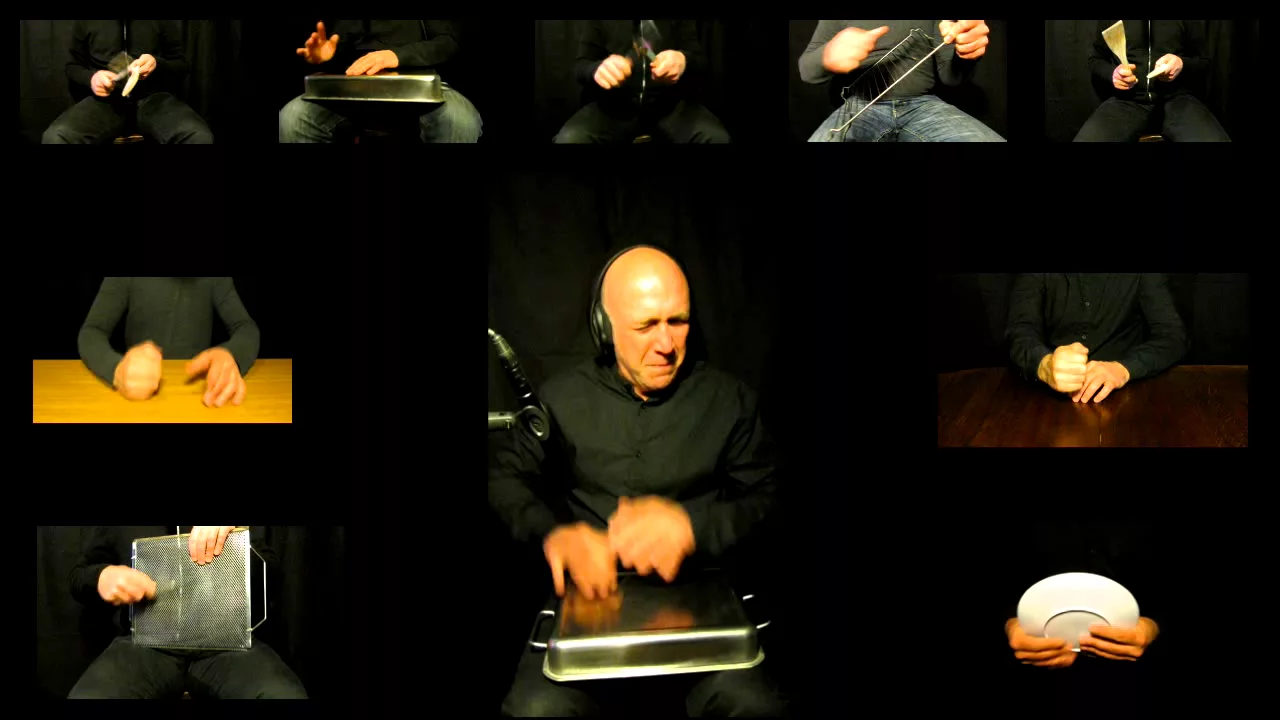
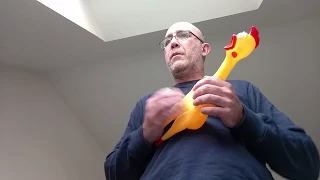
A table. A steel tray. A bucket, a coffee mug, a plastic chicken... all of them have a sound hiding inside, and I show you how to find it. How? You learn to get three usable sounds out of almost anything in thirty seconds: a bass, a mid and a slap, without hurting your hands. Then we put those sounds on a loop station and build a full arrangement, layer by layer.
It's real percussion technique. It just isn't attached to a drum.
Beyond the Drums: Everything is an Instrument
More than a million people have watched these videos, so I decided to open the kitchen drawer and show you what is inside them.
Samba de Mesa is the best example: a percussion trio on Brazilian television, played with kitchen utensils on a bare table. In the course you learn how it works.
Then the curious instruments: the Udini, the Cajita and the Xequebalde, a shekere made from a bucket. Some come from small brands and luthiers, some are just very odd. I show you how each one sounds and how to fit it into your setup.
And the loop station. Jugutaka took me to the semi-finals of the Boss Loop Station World Championship, so I take it apart layer by layer: how to record your first layer without losing the time, where the bass goes, where the groove goes, and what stays out of the way.
Why this sits inside a membership and not on its own
BUT WHY A MEMBERSHIP?
Because of something I noticed after years of playing and teaching... the more instruments that challenge your independence you play, the easier each one becomes. And every course in here asks your two hands to do something different.
On the Cajon with Brush, the dominant hand holds the rhythm with a single brush, like a drum kit on one wooden box, while the bare hand phrases on its own. On the Hand Cajon (arriving in October), the hands alternate most of the time and the groove is shared evenly between them, so neither hand leads. On the Udu Drum, one hand seals the hole with the palm to shape the bass lines while the other keeps the time across the shell. The Caxixi Shaker lives in the wrist: tiny movements, and the timing has to be exact. And Creative Percussion has no tradition to follow, just an object and one question: what can this thing do?
Work on two or three of them at the same time for a month, then go back to your main instrument. Something has loosened. Your hands move with more freedom, and not because you practiced that setup... you practiced around it.
These are not five separate subjects. They are five ways into the same place.
Watch Creative Percussion in action
A quick look at the sound, the objects and the creative
approach you will learn inside the membership.
Choose Your Membership Plan
Get full access to all courses, masterclasses and future releases.
Select the plan that works best for you.
You can cancel anytime. Your membership gives you instant access
to every instrument course, all updates, and all future content.
BEST VALUE — save over 30% annually!
EXCLUSIVE BONUS: Private 30-Minute 1:1 Diagnostic Session with Renato Martins
Full access to all 5 core courses: Cajon with Brush, Udu Drum, Caxixi Shaker, Creative Percussion, and Hand Cajon (arriving October)
Admission to live monthly masterclasses & guest workshops
Instant access to all future lesson drops and rhythm loops
All downloadable PDF notation charts & community access
Cancel anytime
Flexible plan — no long‑term commitment
Full access to all 5 core courses: Cajon with Brush, Udu Drum, Caxixi Shaker, Creative Percussion, and Hand Cajon (arriving October)
Admission to live monthly masterclasses & guest workshops
Instant access to all future lesson drops and rhythm loops
All downloadable PDF notation charts & community access
Cancel anytime
What you will learn
Inside This Course, You Will Master:
- Acoustic scanning:
look at any object and find where it sounds best.
- The 30-second rule:
a bass, a mid and a slap on almost any surface in under thirty seconds, plus scraping and rubbing for more textures.:
- The afuche framework:
friction for sweeping background textures, and hitting the object against your hand for accents. Both belong to the technique.
- Curious instruments:
what the Xequebalde, the Cajita and the Udini can do.
- Loop station foundations:
the first layer decides everything that comes after it. I show you how to start and stop the recording right on the beat, so the loop doesn't wobble when you stack ten more layers on top.
- Stacking the layers:
groove, bass and textures each get their own place... so they support each other and don't fight for the same space.
- The Jugutaka blueprint:
the piece taken apart layer by layer, in the order I build it, so you can play it and then build your own.
- On stage and in the studio:
take found-object sounds to a concert, a recording or a jam.